


The End of Seeking: Why You Are the One You’ve Been Looking For
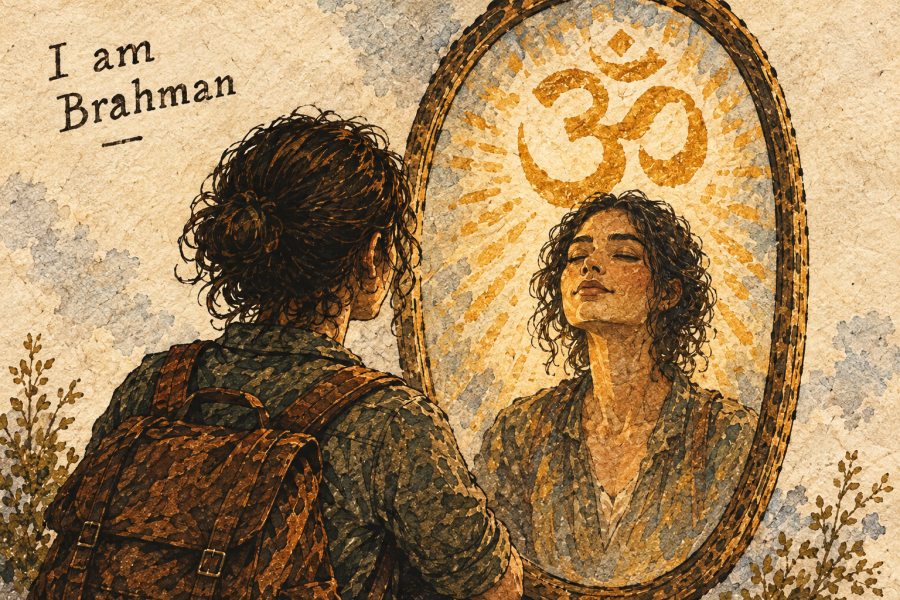
Most of us, and people you know, spend our lives under the impression that we are incomplete.
We feel a subtle, nagging sense that if we just had a better job, a more loving partner, a healthier body, or more money, we would finally be “enough”.
We are like travelers chasing the horizon – and no matter how far we walk, the goal remains just as far away.
Why is this?…
Why Does The “Perfect Life” Always Seem to Be One Step Ahead?
Because you are looking for fulfillment in objects that change and disappear. Even if they didn't, your desirability towards them would, which would make objects change from your standpoint. Yesterday it had a glow. Today it doesn't.
And this “never enough” doesn't mean something is wrong with you. It's everyone's experience. Some are just better at coping. Remove all filters, and that's called greed, or sense of entitlement.
Additionally, suppose the desirable object never changed. That's our wish right. My husband/wife remains forever the person I originally fell in love with!
Who is experiencing the desirable object? I am. Where is the desirable object? Over there. Meaning, there's always a gap between “me” and “that”. That gap alone will bother you.
Even if the phone is mine, moment it's away, I'm disturbed!
The moment the conversation ends, you reach for something else.
Again, this unwinnable game is not a character flaw; it is the natural consequence of looking for what you already are in places where it's not. Meaning each time a person or object disappoints you, it's less about them, and more about your discontent state of mind.
This is exactly why the tradition offers us what it calls ātma-jñāna – Self-Knowledge.
Self-Knowledge is not psychology. It is not a personality profile or a catalogue of your strengths and weaknesses.
It is the discovery that the wholeness you have been running toward is not ahead of you. It is you. It has always been you. You have simply not been shown where to look.
Why Knowledge is the Only Cure
Suppose you are looking for your glasses. You search the kitchen counter, the bathroom shelf, the desk in the study – growing more anxious with each passing minute. But the whole time, unbeknownst to you, the glasses are sitting right on top of your head.
See what is happening here. No amount of searching or action will find those glasses. And this is not because the glasses are hard to find – it is because the search itself is misdirected.
The glasses are not in any of those rooms. They are with you. They were always with you. They never left.
What you need, then, is not more searching. You need one thing and one thing only: the knowledge of where they already are.
The moment someone says, “Look on top of your head”, the search is over – instantly, completely, without your having moved an inch.
Now, bring this same understanding to your sense of incompleteness. The wholeness, the completeness, the sense of “enoughness” that you have been seeking through relationships and achievements and experiences – it is not in any of those places.
It is in the very awareness by which you are reading these words right now.
It is the knowing presence that has been quietly here your entire life, never coming and never going.
It is like those glasses – always with you, never truly separated from you for even a moment. But as long as you believe there is a gap between you and your own wholeness, that gap, however notional, will disturb you.
A believed, non-existent gap – is just as painful as a real one. The search does not end because you acquire something new. It ends because you recognize what was never absent.
This is why knowledge – and not effort, and not years of spiritual striving – is the only true solution.
The tradition illuminates this with two analogies…
The Analogy of the Lamp:
If you want to remove darkness from a room, you do not pick up a broom. You cannot sweep darkness out of a room, because darkness is not a “thing” that occupies space – it is simply the absence of light.
The moment you bring a lamp into the room, the darkness does not go anywhere; it simply ceases to be.
In exactly the same way, the feeling of being small, limited, and incomplete is not a fact about you. It is a misunderstanding – an absence of the right knowledge.
This means the solution is not effort. You do not need to work for twenty years to become the Self, because you already are the Self.
What is needed is the knowledge that clears the misunderstanding, the way a lamp clears the darkness.
And just as reading about lamps will not illuminate your room – the lamp must actually be lit – this knowledge must be received properly, through careful inquiry, for it to do its liberating work.
The Analogy of the Tenth Man:
There is a delightful old story that makes this even clearer. Ten friends cross a river together. On the far bank, wanting to make sure everyone has made it safely, one of them counts: one, two, three… all the way to nine. Nine? He counts again. Nine.
He calls for help, and each of his friends takes a turn counting – and each one arrives at the same number. The group erupts in grief: “We have lost someone!”
A passerby watches this scene, counts them himself, and gets ten. He walks up to the one who started all the counting and says simply, “You are the tenth”.
The tenth man was not lost. He was not somewhere else. He was there the whole time – searching for himself.
And the problem was not solved by any action, any effort, or any spiritual journey. It was solved by a single sentence of knowledge: “You are the one you thought was missing”.
That is what Self-inquiry is, in its essence. You are the awareness/consciousness you have been looking for.
The awareness you are seeking is the very awareness with which you are seeking.
This is not poetic mysticism – it is a verifiable fact, and the entire tradition of Vedanta exists to help you verify it directly, for yourself.
The Architecture of Ignorance: Why We Feel Incomplete
But this raises a natural question: if the Self is what we already are, why did we forget it in the first place?
We are born into a kind of forgetting. Without the recognition that we are already whole, we experience ourselves as empty – as lacking something essential.
And from that sense of lack, desire naturally arises: “I am incomplete, so I must acquire that object to fill the hole”.
We build an entire life around the filling of this hole. We chase, we acquire, we feel briefly satisfied, and then the hole reappears.
It is not a moral failure – it is simply what happens when the wrong identity is taken as the starting point. The wave analogy explains further…
The Analogy of the Wave and the Ocean:
Imagine a wave in the ocean. Looking at the other waves around it – some taller, some faster, some more powerful – it feels small and short-lived. And as it rises and begins to curl, it fears the moment it will crash and disappear. This fear is understandable.
But why does the wave fear? Because it has identified itself as a wave – as a particular, limited, temporary form. It has forgotten that it is, in its very substance, the ocean itself.
A wave is not something separate from water that happens to be floating in water.
A wave is water, temporarily taking on a form.
If the wave could somehow “realize” this – if it could recognize that its true nature is the water and not the passing form – would it still fear crashing?
The form would still rise and fall, yes. But the water is never born and never dies.
In the same way, you are not a person adrift in a vast, indifferent universe. You are the awareness – the consciousness – within which the person and the universe are both appearing.
When this is truly recognized, the “crashing” of life's difficulties no longer carries the same terror, because you know you are the Water, not the wave.
The Duality Trap: How Experience Tricks the Mind
Of course, this is very difficult to accept – not because it is untrue, but because every single moment of our waking experience seems to confirm the opposite.
Our senses deliver one consistent message: “I am in here, and the world is out there.”
There is a subject – “me” – and there is an object – “everything else.”
This feels absolutely undeniable.
Rather than dismiss this experience, we must understand why it arises. And for that, the analogy of the dream can help us…
The Analogy of the Dreamer:
When you dream at night, your dreaming mind creates a complete world – mountains, cities, weather, and other people, along with a “dream-version” of yourself walking among them.
While you are inside the dream, everything is fully real. You feel genuinely separate from the dream-mountains; you interact with the dream-people as if they are truly other.
But when you wake, something becomes clear: the mountains, the people, and the “dream-you” were all made of the exact same thing. They were all made of your own mind. There was no actual separation – only the appearance of separation, within a single awareness.
Vedanta suggests the waking state has precisely the same structure. The world you perceive and the “ego” – your felt sense of being a separate, bounded “me” – are both appearances arising within a single, undivided awareness.
This does not mean the world is unreal; the dream-mountains were entirely real while the dream lasted.
It means that the felt sense of being a tiny, isolated fragment in a vast universe is not the final truth about you.
It is a constructed character with boundaries – superimposed on you, the limitless Self without boundaries.
The Social Echo-Chamber
And if our senses were not enough to reinforce this case of mistaken identity, the world around us adds its own considerable weight.
From the very beginning of life, we are told what we are: we are our names, our grades, our professions, our bank accounts.
This is not said with bad intention – it is simply what the people around us believe, because it is what was told to them.
We are raised by a world that has collectively forgotten its own nature. No one is to blame. But the effect is real, and it runs deep.
The Analogy of the Lion Raised as a Sheep:
A lion cub, separated from its family, is adopted by a flock of sheep. It grows up learning to bleat, to eat grass, to scatter in fear at the sight of predators.
Its nature as a lion is completely intact – it has not gone anywhere – but the cub has no basis on which to question the identity it has been given.
One day, an older lion finds it and leads it to a still pool of water. “Look at your reflection.” The cub looks – and something in it recognizes something…
It did not have to become a lion. It only had to stop believing the story it had been told about itself.
Self-inquiry is precisely this:
it is looking into the “pool” of the teachings and allowing your true nature to recognize itself. But just as a turbulent pool gives a distorted reflection, a turbulent mind cannot receive this recognition clearly.
This is why the tradition does not hand us only philosophy – it gives us a complete and carefully sequenced preparation.
The Three Phases of Inquiry: Shravanam, Mananam, and Nididhyasanam
Hearing a beautiful idea and actually living as that truth are two very different things. To bridge this gap, the tradition gives us a three-step process, each step essential, each building naturally upon the one before.
1. Shravanam: The Art of Systematic Listening
The first step is called Shravanam – sustained, systematic exposure to the teaching through a qualified teacher.
Why “systematic”? Because the Self has no color, no shape, no size, no beginning, no end. It cannot be pointed at. Any statement about it requires precise qualification, because a careless phrase can send the mind in entirely the wrong direction. Without careful guidance, the mind seizes on a partial description and builds a wrong conclusion – and then, worse, defends that wrong conclusion as spiritual wisdom.
Even with age of AI reasoning models, they can't do justice to showing you your vast nature, unlike a qualified living teacher can.
The Analogy of the Map and the Territory:
Think of Shravanam as studying a detailed map of your own home while you are lost inside it in the dark. The map is not the home – it would be a mistake to confuse the two – but without the map, you will keep walking into walls.
The teacher provides the map of non-duality and, crucially, lights the lamp of logic so you can read that map correctly, so you do not mistake a metaphor for a literal description and go chasing the wrong thing entirely.
2. Mananam: The Resolution of Doubt
After Shravanam, the teaching has been heard – but then you return to your life, and the doubts arrive.
“Yes, but… if I am limitless awareness, why do I feel so anxious? Why does criticism still sting? Why does the fear of death not simply vanish?”
These doubts are not a sign of failure; they are actually healthy. They mean the teaching has made genuine contact with your mind, and your mind is now testing it honestly against lived experience.
This second step – Mananam – taking time to resolve doubts through reasoning.
The Analogy of Refining Gold:
Gold ore, as it comes from the earth, is mixed with impurities. You do not remove those impurities by simply believing they are gone. You heat the ore, you hammer it, you apply the right process – and what remains, after every impurity has been burned away, is pure gold.
In the same way, a mere “belief” that you are the Self is a fragile thing. Under pressure, under grief, under the ordinary fears of life, a belief can shatter.
What Mananam builds is not belief but certainty – the kind that comes from having examined every doubt honestly, answered every question logically, and found the reasoning to be sound all the way through.
When that certainty settles in, fear cannot shake it the way it once could.
3. Nididhyasanam: The Assimilation of Truth
Even after the logic is clear and the doubts have been answered, there is still the force of old habit.
The mind has been identifying with limitation for a very long time, and those grooves are deep.
You may know, perfectly well, that you are not limited – and still, the moment someone criticizes you, the old smallness flares up. The old pattern reasserts itself, almost automatically.
This is where the third step becomes essential: Nididhyasanam – the sustained dwelling in the truth, again and again, until it becomes the natural flavor of your experience rather than a conclusion you have to consciously remind yourself of.
The Analogy of the Wasp and the Caterpillar:
There is an old analogy from the Puranas – the Bhramara-Kitaka – about a caterpillar that becomes so intensely and continuously focused on a wasp that it gradually takes on the wasp's very nature.
The logic at work here is important: your identity is shaped, moment by moment, by what you consistently give your attention to.
If your mind dwells constantly on your limitations – your anxieties, your failures, your smallness – then that smallness deepens its hold.
But if, again and again, patiently and without forcing, you return your attention to the truth of your own limitless nature, the caterpillar-identity gradually loses its grip.
The freedom that was always already the case begins to feel like your natural state – because it is your natural state.
Nididhyasanam is simply the patient, loving removal of everything that was covering what was always there.
Preparing the Altar: The Role of Karma Yoga
All of this – the listening, the reasoning, the sustained dwelling – requires a mind that is actually capable of receiving what is being offered.
A mind agitated by intense “should's” and “shouldn'ts”, a mind pulled in all directions by craving and aversion, cannot hold the teaching long enough for it to take root.
Think of a lake: when the surface is choppy, the reflection of the moon is broken into shimmering fragments. When the surface is still, the reflection is whole and clear.
Knowledge requires a mind that is, at least to a reasonable degree, still. And this is the precise role of Karma Yoga.
Karma Yoga is not a performance of rituals – it is an attitude toward action.
You act fully and wholeheartedly, bringing your best to whatever is in front of you, but you remind yourself that you are a participant within an order you didn't create. You, as the body-mind complex, were born in it, and are sustained by it.
The tradition calls this order, Isvara – the total intelligence that governs the laws of physics, biology, and system of action-reaction (karma).
Because you don't govern countless variables that determine who much you'll receive, at what time, and from whom – you come to see that even if life throws you a slap for your hard, sincere efforts – it's not personal. It means, “This has happened, what's next?”.
You remain relatively composed, knowing you're not being punished nor rewarded. The universe is not plotting against you.
You are seeing results in your life as prasada (a gift) from Ishvara.
Results, whether pleasant or unpleasant are gifts, because they remind that you don't run the show. The order doesn't bend to our fancies. This makes the person humble, rather then angry and disappointed when things don't go their way.
This thinking also gradually dissolves the ego's frantic need to control everything. We don't even control what neurons fire-and-wire, what quantity of dopamine is released upon sight of a pleasing object.
Karma-yoga's attitude settles the complaining mind. Like stilling water in a bucket, that's finally able to reflect sun (truth of who and what you are) without distortions.
The Power of Devotion and Prayer
Alongside Karma Yoga, the tradition also offers devotion – bhakti – as a powerful means of preparing the mind. And here, too, there is a common misunderstanding worth clearing up.
In Vedanta, prayer is not an appeal to a distant deity who grants or withholds requests from somewhere above the clouds.
Prayer shows what really matters to you, what's important, what you stand for. It psychologically aligns you to what you want.
The brain hears, “If he or she is taking time and effort to pray for ___, I better start thinking how to bring this into his or her life!”.
Additionally, when you invoke Isvara in prayer – you are acknowledging there's a much larger entity then “me [the small individual whose comparing myself to others]”, that is running the show.
So it softens the rigid ego-me. It reduces arrogance of “I will figure this out entirely on my own”. If you could've figured it out, you would've done it by now!
Additionally, prayer lessens the sense of isolation, the feeling of being a small being who has to fight his way and compete with everyone.
No longer pretending that “I have it all under control” – the knowledge finds far less resistance.
Noteworthy: Devotion does not replace inquiry – it does not do the work of Shravanam or Mananam – but prepares the ground so that inquiry can take root deeply, and stay.
Meditation as a Platform for Inquiry
And finally, there is meditation – and here, too, there is a misunderstanding to gently set aside.
Meditation in this tradition is not about inducing extraordinary states of bliss, not about achieving some spectacular inner experience that you can then display as evidence of spiritual progress.
It is the practice where you relook at old wounds that keep resurfacing in the mind throughout the day. Then reframing the story until it looses emotional grip on you. The fact that something keeps reappearing for you, shows it's not completely resolved, and will continue to bother until you make peace with it.
The second aspect of meditation is bringing in a teaching you've heard in class, a book – and contemplating on its meaning, so it's thoroughly ascertained.
The third aspect of meditation is creating a perfect place where you can recognize the awareness that underlies all your thoughts , that is present before the first thought arises and that remains present after the last thought dissolves.
The Analogy of the Movie Screen:
When you watch a film, you see fire burning, water rushing, darkness and light chasing each other across the frame. The screen, in a sense, “shows” all of this. But the screen itself is never burned by the fire and never gets wet from the water. No matter how dramatic the movie, the screen remains completely untouched, completely unaltered.
Now ask yourself: what, in your own experience, is like that screen?
In meditation, when you sit quietly and simply observe your thoughts without immediately chasing them – you begin to notice something that was always there but is easily overlooked: the awareness in which the thoughts appear.
The thoughts come and go. The feelings rise and fall. The body is here one moment and, one day, will not be. But the knowing itself – the quiet, luminous awareness that makes all of this visible – that does not come and go. That is you. Not the thoughts, not the emotions, not the one who says “I am meditating” – but the unchanging awareness within which all of it is appearing.
When this recognition becomes firm through patient, sustained practice – something quietly and permanently shifts.
The world does not disappear. The person does not disappear. Daily life continues in all its ordinary complexity.
But you begin to see it clearly for what it is: appearances within awareness, not limitations of awareness.
The phantom of a separate, bounded self – the wave that forgot it was the water – begins to lose its grip.
You stop being fooled by what you are not. And that is what freedom looks like. Not the acquisition of something new – but the end of the confusion about something that was never, not even for a single moment, absent.