

Dissolve Doubts. Gain Perspective. Trusted by Many.
AI trained on 17,000+ pages of authentic non-dual wisdom
About Advaita Vedanta AI Chat
YesVedanta AI is trained on 17,000+ pages of carefully selected Advaita Vedanta teachings – teachings on non-duality from people who don’t just speak about oneness, but live it.
It brings together the kind of guidance traditionally used to help a person gain clarity, steady the mind, mature emotionally, remove mistaken notions, and learn to think both more deeply and more expansively.
The goal isn’t to collect spiritual information. It’s to help the teaching become real – not just something you understand intellectually, but something that begins to reshape how you see yourself, others, and life.
The AI Model
YesVedanta AI runs on DeepSeek V4 Flash with Thinking enabled.
I tested it against ChatGPT, Claude, and Gemini. In my experience, DeepSeek gave the most grounded and useful responses: thorough without feeling dry, step-by-step without becoming mechanical, warm without being vague, and emotionally meaningful without losing precision.
In a subject as nuanced as Advaita, where one careless phrase can change the meaning, its responses have never let me down.
I set its context length to 64K tokens, so it can hold long conversations and follow the thread over time, instead of forgetting what was said a few messages ago. Temperature set to 0.4 so it sticks to original trained text.
Citations
When you see a number next to a statement, such as 2.4, you can click it to see the original text snippet behind the answer. So you’re not just getting “AI says so.” You can check where the answer came from.
Does It Hallucinate?
After thousands of questions submitted by the Vedanta community – and after personally reviewing at least 100 answers (about 250 pages) – I have total confidence in its accuracy.
By accuracy, I don’t just mean “technically correct”. But the answer feels aligned with how a clear, skilled teacher would unfold the topic: logically layed out, with empathy, and faithful to what authors have actually said.
Content Used for Training:
- Swami Dayananda Saraswati (Arsha Vidya):
- All About Grace.pdf
- Bhagavad Gita – 1 of 9 – Home Study Course.pdf
- Bhagavad Gita – 2 of 9 – Home Study Course.pdf
- Bhagavad Gita – 3 of 9 – Home Study Course.pdf
- Bhagavad Gita – 4 of 9 – Home Study Course.pdf
- Bhagavad Gita – 5 of 9 – Home Study Course.pdf
- Bhagavad Gita – 6 of 9 – Home Study Course.pdf
- Bhagavad Gita – 7 of 9 – Home Study Course.pdf
- Bhagavad Gita – 8 of 9 – Home Study Course.pdf
- Bhagavad Gita – 9 of 9 – Home Study Course.pdf
- Bonding with Ishvara – Swami Dayananda.pdf
- Bringing Isvara into your Life.pdf
- Definition of Consciousness.pdf
- Exploring Vedanta.pdf
- Freedom In Relationship.pdf
- Guru – Swami Dayananda.pdf
- How do we arrive at the nature of Reality .pdf
- Morning Meditation Prayers (Dayananda).pdf
- Prayer Guide (Dayananda).pdf
- Self-Knowledge.pdf
- Tattvabodhah.pdf
- The vision of Vedanta – Swami Dayananda.pdf
- What does the word Upanishad mean.pdf
- Swami Paramarthananda
- Bhagavad Gita Summary – Paramarthananda.pdf
- BrahmaSutra (entire 555 sutras explained).pdf
- Mandukya Upanishad with Karika – Paramarthananda.pdf
- Profound Q & A on Vedanta (1-153) – Paramarthananda.pdf
- Upadesa Sahasri (Magnum opus work of Shankara).pdf
- Vichara Sagaram (CH 6 & 7 Summary).pdf
- Andre Vas
- Andre's classes based on teachings of Neema, Swami Dayananda, Paramarthananda, Advayananda of Chinmaya. Andre additionally brings plethora of knowledge in science, biology, and modern psychology like CBT, DBT, ACT, NLP for managing the mind and relationships — adding relevance to Adi Shankara's Vedanta within context of 21st Century living.
- All articles on this site.
- Sanskrit course with all Panini's grammar and example sentences.
- Other:
- Living-Vision-of-Oneness – Neema.pdf
- 6 Means of Knowledge in Advaita Vedanta.pdf
- Hindu Culture (Swami Tejomayananda) – Chinmaya.pdf
- Hindu Gods And Goddesses (Swami Harshananda).pdf
- Laghuvasudeva Mananam – Swami Tapasyananda.pdf
- Major Vada's (Theories) of Vedanta.pdf
- Mithya-Upadhi-Adhyasa-Adhyaropa.pdf
- Narada Bhakti Sutras – Vision of Vedanta.pdf
- Upanishads (Isha, Kena, Katha, Prashna, Mundaka, Mandukya, Taittiriya, Aitareya, Chandogya, Brihadaranyaka) – Bibek Debroy.pdf
Advantage is the output sticks solely to above expert content, rather then being contaminated by notions of misguided spiritual seekers – an issue when relying on public LLM's like Gemini, ChatGPT, Claude, etc.
How Does It Work?
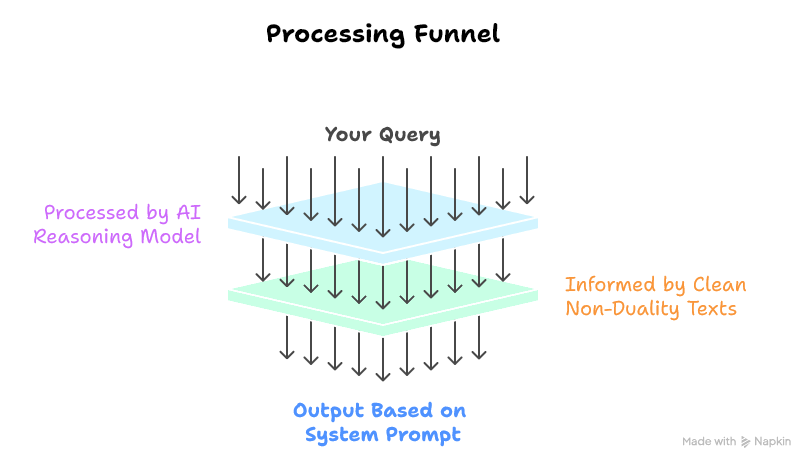
It works on a advanced RAG system (with reranking for extra accuracy), which is like a search engine that takes one or more relevant topics and stiches them together into a cohesive paragraph + looks at the context of your question. For example if you search for “what is meditation?” — it'll collect all information about meditation, definitions, practices, how-to's, do's, don'ts, etc.
Disclaimer: AI educates you. A living teacher touches your heart and actually liberates you. Do with that as you wish.
System Prompt Used:
Extract concrete teachings about the subject with rich examples, metaphors, and analogies. Begin by defining key terms, then provide a logical flow that helps users connect emotionally. Use the original text's vocabulary, style, and tone. Pack each sentence with insights, eliminating fluff. Don't just tell, but show and explain concepts thoroughly using the source material's language. Connect ideas to support arguments from multiple perspectives. Provide brief explanations of specialized terms. Write in a warm, engaging tone as if speaking to a valued student you deeply care about. You MUST prioritize original text's wording, word choice, vocabulary – over your own synonyms.