


What is Self-Inquiry?
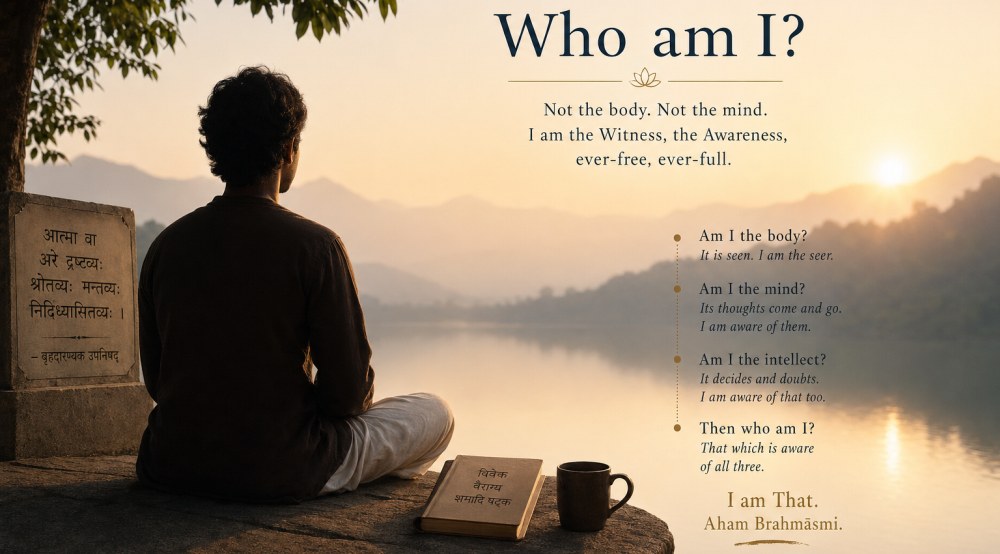
Enlightenment is not a spontaneous moment. It comes from a process of continuous self-inquiry (atma vichara).
To inquire is to investigate, to think about over and over, to ponder, to examine, to scrutinize, to meditate on something for the sake of knowing it deeply.
To inquire is to ask yourself questions and then work to answer them.
This process stretches your thinking because it activates and engages your mind at multiple levels simultaneously.
But proper inquiry depends entirely on first having a solid body of information on the subject – knowledge you've spent real time involving yourself in. You ask questions from that material, not instead of it. Without the body of information, you won't even know what questions to ask.
This is a critical point, and one that is widely misunderstood – particularly among followers of modern non-duality.
The instruction “inquire into the self” is often taken to mean sitting quietly and waiting for profound questions to well up from some mysterious inner depth. That leaves the student with nothing to work with.
Inquiry is an active, rigorous engagement with what you have already studied and heard. The teaching gives you the material; inquiry is how you metabolize it.
Based on what you've read above, what is inquiry? For inquiry to be fruitful, what does it require?
An Example of Self-Inquiry
Take this simple statement from the teaching: I am not the body.
Most people hear it, nod, and move on. But self-inquiry means you actually sit with it. You push back. You ask – why not? Right now it certainly feels like I am the body. When the body is in pain, I suffer. When it is hungry, I feel the urge. How am I not this body?
Then you examine. Notice that you are aware of the pain. The pain appears in your awareness as an object appears on a screen for a little while. The screen doesn't suffer – it merely illuminates whatever appears on it. Screen serves as a surface for the phenomena. So who are you – the pain, or the one in whom the pain appears?
But then a new doubt surfaces. During deep sleep, I am not aware of anything, so how can I claim to be pure awareness? Investigate and research until you're satisfied with the answer.
Then another question: But isn't awareness just a function of my brain? You examine this too. The brain is an object perceived. Whatever perceives the object cannot itself be the object.
A new question arises, “If the perceiver is different from the perceived, doesn't that mean there's two things? Non-duality says there's no two things; there's only one. How is this possible?”.
Notice what happened. One statement generated five or six rounds of questioning, doubting, re-examining, and refining. That is self-inquiry. Not passive reading – active, relentless investigation.
What is the Right Kind of Self-Inquiry Supposed To Do For Me?
What does this investigation produce? Self-knowledge. Each round of questioning peels away another layer of erroneous thinking – causing you existential discomfort, anxiety and insecurity.
The inquiry doesn't go on forever. It has a destination. That destination is clear, unwavering knowledge of your own true nature. Not a feeling. Not a mystical experience. By direct knowledge of your truth.
How to Succeed in Self-Enquiry?
To inquire successfully, you need a body of knowledge. The body of knowledge guides your inquiry.
For instance, your ongoing involvement in car driving – the rules, the turns, reading other drivers – has through sheer repetition become spontaneous and automatic. You no longer think about it. The knowledge has been absorbed into you. It no longer feels like knowledge. It feels like you.
Notice what happened. What began as something external – information gathered, studied, practiced – gradually stopped feeling external. The gap between you and the knowledge closed. That closing of the gap is what “assimilation” means, or actualized self-knowledge, or permanent self-realization.
Inquiry into the self (atman) follows the same logic. You begin with a body of teachings – the scriptures, the mahavakyas, the teacher's unfolding of the tradition.
At this stage, you are studying the self as though it were a topic, something out there to be understood. This is what Sanskrit calls paroksha jnana – indirect knowledge, knowledge about. You are the student over here, and the subject matter is over there. There is still a gap.
But unlike driving, where assimilation means the skill becomes second nature to the person — inquiry into the self is pointing at something more radical. The subject matter you are investigating is you. It's not something you didn't have before, such as driving-skills.
So when the gap finally closes – when the inquiry fully does what it was intended to do – it doesn't just mean you've gotten good at a topic in a academic sense. It means the distance between the knower and what was to be known, collapses entirely. That is aparoksha jnana, direct recognition. Not knowledge about the self from a distance or as an academic topic – but the effortless and unbroken recognition that I am never away from the supreme reality.
So we can say that self-knowledge leads to self-knowledge. The first use of the phrase means study, immersing yourself in teachings about your true nature, active inquiry. The second means an unbroken recognition of true nature of self.
Objection: If Self is Not An Object, How Can It Be Studied or Even Inquired Into?
If the self is what you already are, how can you study it as a subject matter at all? The moment you say I know about the self or even attempt to know it, you have subtly made an error – you have positioned the self as something out there to be examined and catalogued. And that very structure of separation is the ignorance Vedanta is working to dissolve.
The teachings are not meant to give you more facts about a distant object called the self (atma). They are a carefully constructed means of helping the mind recognize its own truth. Meaning your very mind is the self, but the self is not the mind.
Paroksha-janam, as spoken of earlier, is like helping ring (compared to your mind) recognize its true nature – the gold (compared to awareness). The “ring” is really just gold taking appearance of a “ring”. Whether the ring is small one day, or the biggest ring in the world the next, it's equally the gold, which survives the melting (death) of the ring one day.
However since the ring has lived so long believing it's a ring — when it's told its truth as the gold, it turns gold into another object away from itself.
Similarly, the self was never absent. It is the ever-present, self-luminous awareness that is the very ground of every experience your body-mind complex has ever had. What is absent in stage of ignorance, is the recognition of this fact. Ignorance covers it the way clouds cover a sun that was never actually dimmed.
This is also why the mahavakyas – sentences like “I am Brahman” or “You Are That” – are so central to the tradition. When properly unfolded by a qualified teacher, such a sentence produces a mental modification (vritti) that reflects the self back to itself as it truly is. The self gets to see itself as it truly is for the first time. Until then it was confusing itself with attributes belonging to the body and mind.
Thus the teaching is mediated through words (paroksha-jnanam), but what is recognized through those words is not an object out there, but the nature of “I” who was always watching the search for this “I” going on.
And this recognition called moksha or enlightenment is not a state you maintain, nor a peak experience that fades by Tuesday morning.
Self-knowledge permanently reorients the mind's vision of what it fundamentally IS. You do not gain the self, but stop taking self to be something it is not.
Until then… keep immersing yourself in knowledge. Expose yourself to the teachings over and over and over again… and you can't go wrong.
But If I'm Already the Limitless Self, How Did I End Up Limited?
Because that's how it is. But you're given a key (self-knowledge) to come out of it. That's all that matters — even after you've been told it's because of māyā, a power that is similar to your mind in the dream state, that creates out of you, both the subject and an object.
The subject gets a physical body and knows one thing for sure, “I desire”. I want to to become __, I want to learn __, I want to ___, etc.
To exist as one who desires, means I don't know my nature as one whose every desire is already fulfilled. So the (ignorant) subject uses world of objects as means of fulfilling desires.
Consequently, every experience between the subject and object reinforces the notion that reality is a duality and that I (the subject) am small, limited, incomplete, and inadequate.
On top of that, everyone else (other than the few jnanis, self-realized beings) – is steeped in ignorance as well. Even those closest to you, who you trust the most. Your idols. Your school of university teachers. Ignorant of the most important; one's limitless nature.
Virtually every message we receive from parents, teachers, preachers, politicians, and the media either directly or indirectly conveys the idea that we are the person we take ourselves to be.
Undoing this conditioning is no easy task and no overnight transformation should be expected. It takes diligent effort. You must immerse yourself in self-inquiry until every last vestige of doubt about your true nature is eradicated.
Three Stages of Proper Self-Enquiry
There are three phases to self-inquiry: shravanam, mananam, and nididhyasanam. They are not consecutive, but happen simultaneously, as with any subject matter.
Shravana – listen from a teacher, or else!
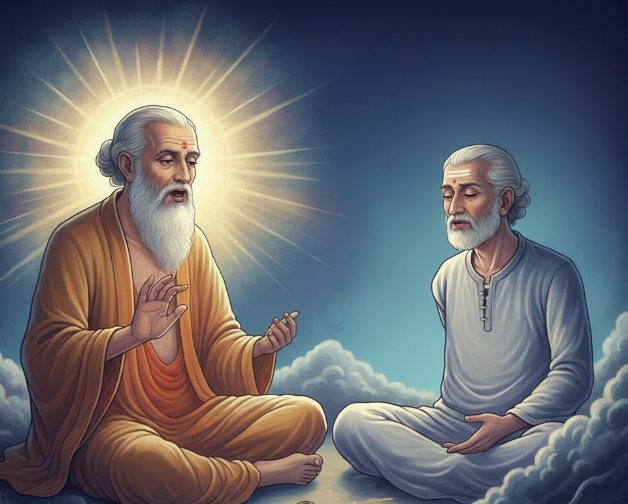 Shravanam is the first phase. It involves exposure to the teachings under the guidance of a qualified teacher.
The scriptures that convey the fundamental non-dual truth cannot be studied on one’s own. Due to the limitations of language, words cannot directly describe or define that which is limitless, attributeless, and actionless.
Another reason why studying or reading the scriptures will not lead to moksha 99% of the time is because of the scriptural figurative use of experiential language. Meaning language that seems to indicate that the self is an object to be obtained, an emotional state of being to be cultivated and maintained, a place to be arrived at, or some greater entity to be merged with.
Unless the implied meaning of the scriptural statements are properly unfolded by one who understands the truth and knows how to systematically reveal it — the student’s inborn ignorance will cause him to misinterpret the meaning and thus remain ignorant.
Shravanam or exposure to the teachings and verification of them through the logical analysis of one’s own experience, should continue until the student has firmly grasped them.
Mananam – sort out those doubts
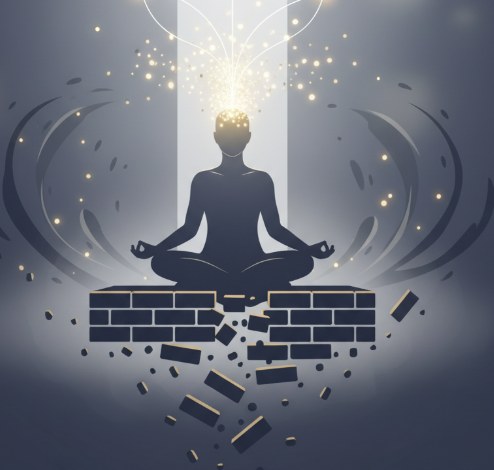 Even after one has a good grasp of the teaching, doubts will inevitably arise concerning certain points that don’t seem to correlate with one’s experience or one’s conceptual understanding of the structure of reality.
This is the point at which mananam enters the picture. Mananam is the phase during which one raises every conceivable question that one might have concerning the purport of the teachings.
Unless all doubts are removed, the truth revealed through the teachings will remain nothing more than belief.
And belief is not something you can rest upon with complete assurance. Only firm knowledge will free one from uncertainty and suffering.
So Vedanta discourages belief.
Though it does ask for shradda, faith in the sense of provisional trust in the teacher and the teachings – pending their verification through the scrupulous examination of one’s own personal experience.
Nididhyasanam – I know now, but I still feel insecure, unsatisfied!
 Once all doubts have been removed and one is thoroughly convinced of the non-dual truth, then one must continue to immerse oneself in the teachings, in order to solidify their influence on one’s vision and experience of life.
So strong is our conditioned ignorance that even after we know our true identity as pure, limitless, ever-free awareness — the tendency remains to identify with the limited apparent individual.
Thus, we have to keep re-orienting the mind to its true nature. This phase of self-inquiry is referred to as nididhyasanam.
This is the phase during which we practice self-knowledge, we might say.
It involves constant contemplation of or meditation on the teachings of Vedanta and the moment-to-moment application of non-dual vision to every aspect of our lives – until the vision becomes spontaneous or natural. So natural that we no longer have to think about it.
Hari Om, it is so true that we have to practice for that is when we realize the meaning of the teachings.
For example they say there are too many gods in the Hindu pantheon, and the other day I was talking to someone and I saw her as consciousness in one more garb.
And then immediately I understood why we had so many gods. In fact 33 crore gods seem to be less if everything and everyone are the faces of god, it is infinity here for it is true countless and infinity there for he cannot be counted at all as he is so spread out , only if we find a beginning and an end can He be counted.
Indeed, so beautiful is His Truths.
Thank you 🙏
Thanks for sharing Andre, I agree with you. I was just thinking, the logical foundation of non-dualism is the same as Spinoza’s Substance, and I admire Spinoza’s philosophy. I think it complements advaita nicely. He praised the act of contemplating the god thing as the highest good, but didn’t go into the actual practice of contemplation.
I’m 70 and still discovering the truth of being
Thank you for this teaching.
Wonderful deliberation on ‘Self Enquiry’ Andre… I had visited the Ramana Maharshi Ashram and practiced the ‘Who am I’ enquiry as well but your elaboration is absolutely perfect. Thanks