


Summary:
Mandukya Upanishad, Verse 10: “U” represents Taijasa, the dreamer operating through the subtle body, which is superior to the physical because it survives death and drives action. “U” is intermediate, just as dream is between waking and sleep. Meditation means identifying as Hiranyagarbha (total intellect) rather than the limited individual. The knower becomes equal toward others because understanding softens reactions – he sees everyone acts from pressures and confusion.
Mandukya Upanishad, Verse 11: “M” represents Prajna, the causal condition where tendencies, desires, and ignorance remain in seed form – ready to reassert upon waking. “A” and “U” merge into and arise from “M,” just as waking and dream resolve into sleep. “M” also symbolizes right timing – anything overextended loses meaning. Meditation means seeing yourself as the Self holding potential for the universe's manifestation and resolution.
Mandukya Upanishad, Verse 12: Turiya is amatra – Awareness not confined to any state, like a screen present through every movie and the interval between. Amatra also means silence: the witness of dissolution doesn't dissolve. It is avyavaharyah – not available for transaction or objectification. Ishvara has both mithya (changing) and satya (unchanging cause) aspects; thus don't dismiss Ishvara as entirely mithya. Ultimately, even mithya is satyam. OM meditation involves visualizing the universe arising and resolving into oneself, then resting in silence and recognizing the unfindable witness as Atman.
Gaudapada Karika, CH1, V7-9: Some say creation is God's real glory, Buddhists say it's emptiness, others say time or nature produced everything on its own, Sankhyas say nature creates for a conscious experiencer, and some say God created for enjoyment or play. Advaita rejects all these – God is already complete so has no need, inert nature can't intelligently create by itself, and enjoyment implies something is missing. Creation is maya, like seeing a snake where there's only a rope; the wise seek the reality behind the appearance, not the appearance itself.
Mandukya Upanishad – Verse 10
“U” – The Second Letter: Taijasa / Hiranyagarbha
स्वप्न-स्थानः तैजसः उ-कारः । द्वितीया मात्रा । उत्कर्षात् उभयत्वात् वै उत्कर्षति ह वै ज्ञान-सन्ततिम् समानः च भवति न अस्य अब्रह्म-वित् कुले भवति यः एवम् वेद ॥१०॥
svapna-sthānaḥ taijasaḥ u-kāraḥ | dvitīyā mātrā | utkarṣāt ubhayatvāt vai utkarṣati ha vai jñāna-santatim samānaḥ ca bhavati na asya abrahma-vit kule bhavati yaḥ evam veda ||10||
Taijasa, whose sphere of activity is the dream state, is the second letter U, because of the similarity [between the two] – coming later or intermediate position. He who knows thus increases the continuity of knowledge, becomes equal [towards others]. No one is born in his family who is not a knower of Brahman.
Chinmaya: He who is taijasa, having for his sphere of activity in the dream state, is ‘U' the second letter; on account of ‘superiority' or on account of ‘being in between the two'. He who knows this attains to a superior knowledge and is treated equally by all and finds no one in his line of descendants who is not a knower of Brahman.
- MEANING OF ‘U’: Second syllable “U” stands for Taijasa, the dreamer, whose experience is through subtle body, inner world, thought, imagination, and mental impressions. “U” also includes Hiraṇyagarbha, total cosmic intellect. Subtle body is treated as superior (utkarṣāt) to physical body, in sense that subtle body doesn't die when physical body does – and physical actions depend upon subtle-body's desires.
- LOGIC OF SYMBOLISM: Taijasa is between waking and deep sleep. “U” is between other two letters.
- MEDITATION: While chanting or mentally holding “U,” you include both: the individual subtle-body with little knowledge, and the total subtle-body Hiraṇyagarbha with total knowledge.
- PURPOSE: The point is to stop seeing yourself as the individual subtle body, with only limited knowledge (alpa-jñānam), and meditate as though you are Hiraṇyagarbha, the total subtle body / total intellect. Through this meditation, the range and power of knowledge increase.
- “…becomes equal [towards others]…”:
- The knower becomes samāna, equal, not by following a rigid rule of “treat everyone the same,” but because his understanding has softened his reactions. He sees that people act from pressures, limitations, desires, fears, and confusion; everyone is carrying some battle. So he is not easily disturbed, and not compelled to divide people sharply into “friend” and “enemy.” Whereas the commoner takes the waking world as absolutely real, so people’s behavior deeply shakes him. Everything must fit fixed expectations, social rules.
- “…and finds no one in his line of descendants who is not a knower of Brahman”:
- Means he finds others who are also knowers of Brahman. This does not necessarily mean blood family.
Mandukya Upanishad – Verse 11
“M” – The Third Letter: Prājña
सुषुप्त-स्थानः प्राज्ञः म-कारः । तृतीया मात्रा । मितेः अपीतेः वा मिनोति ह वै इदम् सर्वम् अपीतिः च भवति यः एवम् वेद ॥११॥
suṣupta-sthānaḥ prājñaḥ ma-kāraḥ | tṛtīyā mātrā | miteḥ apīteḥ vā minoti ha vai idam sarvam apītiḥ ca bhavati yaḥ evam veda ||11||
Prājña, whose sphere is deep sleep, is the third letter M, because both are measured [contained] [by it] and also because in it both are absorbed [or become one]. He who knows this is able to measure all this [universe] and becomes the place of absorption [of all].
MEANING OF “M”:
Third syllable “M” stands for Prājña, the deep-sleeper.
“M” also points to causal condition, where all the causes for you to experience a new day, exist in potential. Meaning grooves (Saṃskāras), desires, and ignorance (“I’m a limited being”) are held in seed form. For instance, next morning:
-
- Tendencies (or vāsanās; which are expressions of saṃskāras):
- the anxious person again worries
- the ambitious person again plans
- the jealous person again compares
- the spiritual seeker again wants mokṣa
- the smoker again wants a cigarette
- Desires (push that makes you want to do different things from another) / karma-phalas:
- attachment to someone
- intention to meditate
- guilt for something bad you’ve done / attraction towards musical instruments
- Tendencies (or vāsanās; which are expressions of saṃskāras):
In sleep, jiva doesn’t know whether it’s a bird, a dog, human, snail, monkey.
LOGIC OF SYMBOLISM:
“A” and “U” both merge into “M”, and arise from “M”. Same applies to waking/dream, both resolves into and emerge out of sleep.
“M” Also Symbolizes Right Timing:
The last sound when you finish pronouncing any word is “M” – the closing of the mouth. Closing the mouth at the right time is what gives a name its meaning. In the same way, the laws of nature make forms unmanifest at the right time, so that any given moment can make sense. For instance:
-
-
- A song must end on the right note at the right time – let it drag on and the melody loses harmony.
- A season must give way to the next – if summer never ended, cycle of growth collapses.
- A conversation must reach its natural close – someone who talks too long, turns to noise.
-
“M” is therefore a reminder of knowing when to stop. Anything overextended loses its meaning. Furthermore, just like you don’t over-extend any word (like “hello”), do not overextend pronunciation of “OM”.
MEDITATION:
While chanting or mentally holding “M,” you include both: individual Prājña, into whom your waking and dream experiences resolve every day, and the total causal source, into which the whole world resolves and from which it manifests again.
PURPOSE:
The point is to stop seeing yourself as merely waker or dreamer, and understand yourself as the Self into whom resides potential for the universe. To see that the world comes because of your presence, is sustained by your presence, and resolves back into you.
SUMMARY SO FAR:
So far, all names in relation to physical, subtle, causal – have been included.
NEXT VERSE: What is the truth of OM (physical, subtle, causal)?
Mandukya Upanishad – Verse 12
“Amātra” – The Fourth Letter: Turīyaḥ
अमात्रः चतुर्थः अव्यवहार्यः प्रपञ्च-उपशमः शिवः अद्वैतः । एवम् ओं-कारः आत्मा एव । संविशति आत्मना आत्मानम् यः एवम् वेद ॥१२॥
amātraḥ caturthaḥ avyavahāryaḥ prapañca-upaśamaḥ śivaḥ advaitaḥ | evam oṃ-kāraḥ ātmā eva | saṃviśati ātmanā ātmānam yaḥ evam veda ||12||
The Fourth [Turīya] is without parts [amātra] and not available for any empirical transaction; It is where the phenomenal world is resolved; It is śiva (auspicious, pure, full) and non-dual. This OM is verily Ātman. He who knows thus enters into Ātman through his own self.
What is Turiya?
Turiya is Amātra (Partless / Not any one form):
Just as all sounds resolve into silence; all names, forms, states, knower, knowledge, and known resolve into the Self (turiya). Similarly, Awareness is not contained within or confined to, any one given form, sound or state. It is that which accommodates everything, yet is free of what it accommodates.
Awareness is like a non-dancing lamp; bringing to awareness the dancers on the stage and also the empty stage after dancers are gone. The waking-state, dream-state and sleep-state are like three different stages, and what happens in each stage are the dancers.
Screen and Movie Metaphor: The waking world is one movie, the dream world another, and deep sleep is like the blank interval when no picture is projected. But the screen remains in all three. Turīya is that screen.
Beads on a String Metaphor: Each experience is like a bead: “I woke,” “I dreamt,” “I slept,” “I know.” The beads are noticed first; the thread is missed. The unbroken “I” Consciousness is the string passing through them all. The beads change; the string remains. Without Consciousness, there is no continuity through waking, dream, and sleep. Turiya is like a shining wire connecting 3 balls (waking, dream, sleep) together – illumining their inside contents.
Why is Turiya called “forth”? Turīya is called “fourth” only from the standpoint of the first three. It is like calling the screen “the fourth” after three different movies; in truth, the screen was present throughout all movies.
Amātra can also mean “silence”:
Every sound dies into silence. Every thought dies into awareness. Every moment disappears as soon as it appears. Meditation on amātrā (silence) teaches you to see this constant dissolution and discover that the witness of dissolution does not dissolve.
When turiya is equated to “silence”, it’s only symbolic of that which doesn’t interfere. For example, a sound of a clap can only be distinctly known if it originates on a soundless substratum (a background that isn’t already filled with sounds). Similarly, when you’re noticing the silence between each “OM”, the very recognition, “there is silence,” proves the presence of Consciousness. When silence goes away, witnessing presence continues.
Turiya is Avyavahāryaḥ (not available transactionally):
Awareness isn’t something you can engage with, study, appreciate, worship. Neuroscientists, studying consciousness, are committing all the mistakes. Before, they use to say consciousness is result of two brain hemispheres working together. Now they're saying, actually, each hemisphere has its own independent consciousness, which is how patients with half a brain removed, are able to continue being conscious.
Turiya is Prapañca-upaśamaḥ (free from mithya [universe/prapanca/jagat]):
Both jiva and Ishvara (knowledge and power) are mithyā. The truth of both is Awareness. Just as atom is free of clay, gold, water… in same way Ishvara (knowledge) is free of atom. And Awareness is free of Ishvara.
However, understanding oneself as free from the universe and Ishvara – does not mean dismissing them. If one does that, one disassociates from the very order one is embedded in and inseparable from. You can’t separate satya-mithya.
Thus, don't make the entire Īśvara mithyā.
One aspect of Īśvara is mithyā – namely the appearances, the manifested forms. But another aspect is satyam – the unchanging material cause, the vivarta-upādāna-kāraṇam. It is ultimately incorrect to say “Īśvara is mithyā”; we only say that provisionally.
For example: when the ocean says “I am the ocean,” there is one aspect that is mithyā – the totality of all waves – and another aspect that is water. The waves are resolved in water, but water is not negated.
Clarity means seeing the satya-mithya relationship in everything. For example, Īśvara can say, “I am manifesting as your buddhi” – if “I” refers to all-knowledge. Īśvara can also say, “I am free of your buddhi” – if “I” refers to Awareness.
If Īśvara could speak, even Īśvara wouldn't say “I am the truth of you.” Thus what to say of an individual claiming “I am the truth of Īśvara.” Instead, Īśvara's understanding is: “My truth as samaṣṭi, and your truth as vyaṣṭi, is Awareness.”
ORNAMENT AND GOLD: Waker, dreamer, sleeper, world, body, mind… are like ornaments – ring, bracelet, necklace. Turīya is like gold. Names and forms differ, but the substance is one. The wise person does not get lost in the ornament-name; he recognizes the gold-substance.
Evam oṃ-kāraḥ ātmā eva (OM Is Verily Ātman):
With this understanding, Mandukya declares that OM (Ishvara) is verily Ātman.
Saṃviśati Ātmanā Ātmānam Yaḥ Evam Veda: He Who Knows Thus:
Who, then, is the one who knows the Absolute? It is the individual who no longer sees the self as separate from Awareness – who no longer sees Ātman as different from Brahman.
Meditation:
While chanting Oṃ, do not rush from one Oṃ to another. After A-U-M, notice the soundless interval. In that silence, recognize: the waking person, dreamer, sleeper, physical body, subtle body, causal condition, and the whole universe of plurality have resolved. Hold the understanding that consciousness is that by which silence is known.
How the OM Meditation Works
PROBLEM: I, the ātmā, am like the crystal. I seem to appear as Viśva, Taijasa and Prājña. The meditation will help you see this.
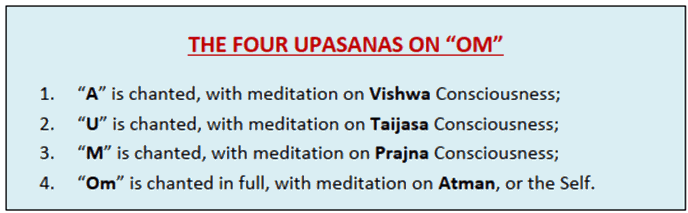
Step 1: Chant Om
Chant Om as a single flowing sound (not three separate letters). The “a” and “u” blend into the “o” sound naturally, followed by “mmm.”
Step 2: Visualize as you chant
Method 1: As the “ooo” sound begins, visualize the entire universe arising out of you. As the “ooo” sound sustains, recognize the universe as remaining within you. As the “mmm” sound closes, visualize the universe resolving back into you.
Method 2: As the sound “aaa” begins, imagine arising out of you, the Vaiśvānara (entire physical universe which includes your body). When transition into “uuu”, imagine arising out of you, Hiraṇyagarbha (total knowledge making all things what they are, laws). When “mmm” comes, imagine in you unmanifest potential (all those things that were, and things yet to come). Eventually, combine “a” and “u” into “o”. At very start of “o”, think of Vaiśvānara (total physical), then think of Hiraṇyagarbha (total subtle / all-knowledge).
Method 3: As the sound “aaa” begins, imagine arising out of you, the waking world in whom are billions of beings, and one of them is your body. When transition into “uuu”, imagine in you beings who are dreaming their own world. When “mmm” comes, imagine in you beings sleeping, oblivious to causes yet to come tomorrow for each. Eventually combine “a” and “u” using same idea as in Method 2.
Step 3: Rest in the silence after the chant
After the “mmm” fades, do not begin the next repetition. Stay in the silence for a while.
Step 4: Investigate the witness
Look for whoever is witnessing the silence. Search for the observer.
Step 5: Recognize what you are
Eventually you'll see you can't find the observer. You’ll realize the observer (turiya) is observing the mind trying to find the observer. That effortless observer (turiya) is atma. It is the knower of silence.
Step 6: Repeat
Begin the next Om and continue the cycle.
— This ends Mandukya Upanishad —
|| iti māṇḍūkyopaniṣat samāptā ||
From now on, it'll be Guadapada Karika until end of the course…
GAUDAPADA KARIKA
Gaudapada Karika – CH1, Verse 7
Creation Theories vs Truth
- Theistic creationists say creation is God’s real glory: Some theistic schools treat the world as a real expansion of God, His glory (vibhūti). In the commentary, this points especially to views that place God in a separate divine realm, like Vaikuṇṭha or Goloka Vṛndāvana, creating the universe as something real. But if the world is absolutely real, God becomes separate from it. Advaita avoids this by saying the world is God’s glory, but dependent reality (mithyā) – not separate absolute reality.
- Mādhyamika Buddhists say creation is dream or magic: The commentary specifically connects this view with the Buddhists (Bauddhas), especially the Mādhyamika tradition and the Laṅkāvatāra Sūtra style of thought. They say the world is like dream or magic, arising through thought, with emptiness (śūnyam) underneath. Advaita agrees that the world is appearance-like, but disagrees that there is only emptiness underneath. For Advaita, every appearance needs a basis, like a snake needs a rope; the world appears on Brahman.
- Advaita Vedāntins seek the “magician,” not the trick: Śaṅkara’s Advaita says the serious seeker is not a creation-obsessed thinker (sṛṣṭi-cintaka). The example is the magician’s rope trick: people see the magician climb, disappear, fall in pieces, and return, but they know it is only magic. Similarly, the wise seek the hidden reality behind waking, dream, and deep sleep – the “fourth” reality, the real Self (Turīya).
Gaudapada Karika – CH1, Verse 8
Will, Time, and Nature
- Theistic schools say creation is God’s will: Some God-centered thinkers (Īśvara-vādins) say God’s will always comes true (satya-saṅkalpa), so the world appears by His mere will. Advaita accepts scriptural statements like “He desired to become many,” but they must be read with other Upaniṣadic teachings: Brahman is limitless, non-dual, and without lack. So “will” is a teaching device, not proof that Brahman really changed.
- Time-thinkers / nature-theorists say creation comes from time or nature: Generally, they say that forms organize themselves. The verse names time-thinkers (kāla-cintakāḥ), those who explain creation through time (kāla). The commentary broadens this to nature-theorists, who say natural processes produce everything through cycles and change. But inert nature cannot intelligently organize the universe by itself unless there is consciousness behind it. If we say “nature did it” and stop there, we have not explained the deeper cause.
- Sāṅkhyas say nature creates for the experiencer: Generally, they say Intelligence/prakirti organizes itself into this world. The commentary also calls out the Sāṅkhya view: primordial nature (prakṛti/pradhāna) creates the world for the conscious experiencer (puruṣa). But Advaita questions this because nature is inert; an unconscious principle cannot purposefully create for anyone unless supported by consciousness. So Advaita says these views are only partial, like touching one part of an elephant.
Gaudapada Karika – CH1, Verse 9
Creation Is Not God’s Need
- Enjoyment-theorists say creation is for experience: Some thinkers say the world exists for enjoyment or experience (bhoga). But enjoyment implies incompleteness: someone seeks pleasure because something feels missing. God is already fulfilled, with all desires satisfied (āptakāma), so He cannot create out of need.
- Divine-play theorists say creation is God’s play: Others say creation is divine play or sport (krīḍā/līlā). But if play means God wanted entertainment, that again implies desire. Also, a world full of suffering cannot easily be explained as mere amusement.
- Advaita Vedānta says creation is māyā, not desire: Śaṅkara’s argues, just as a rope appears as a snake due to ignorance of the rope, Brahman appears as the world due to māyā’s avarana-shakti. EG: A straight stick looks bent in water / Shell looks like silver.
—
Recorded 7 July, 2026