


Summary:
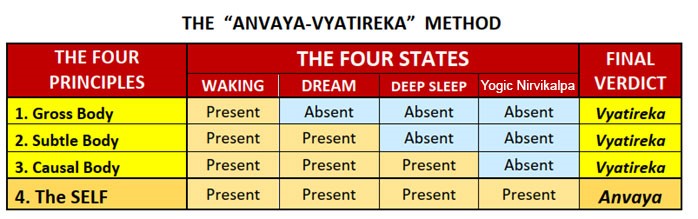
Vivekachudamani, Verse 36: Ātmā is the effortless and continuous sākṣī (witness) in reference to the availability and non-availability of the mind and its vṛttis across waking, dream, and deep sleep. The three states don't happen outside you; that's why they're known; showing there is a common, unbroken witness in reference to the three states.
Vivekachudamani, Verse 37: The Self sees everything by itself without any external aid – it is self-evident and self-existent. Yet no one can see Awareness, for nothing stands behind the seer. Ātmā illumines the mind, but the mind – like objects revealed by light – can never reveal the light itself.
Vivekachudamani, Verse 38: Paramātmā is prakṛti-vikṛti-bhinnaḥ – distinct from both cause (Māyā) and effect (jagat) – and is śuddha-bodha-svabhāvaḥ, pure consciousness never tainted by upādhis. It illumines without exception all forms (sat) and formless elements (asat), remaining nirviśeṣaḥ (attributeless), shining directly as the witnessing “I” behind the changing ahaṅkāra-I.
Vivekachudamani, Verse 39: Bondage is the thought “I am this” – placing the sense of ‘I' into anātmā. Born of ajñāna, this causes one to take the impermanent body as real (satyam) and superimpose Ātmā's limitless nature onto the mithyā body-mind. Like a silkworm trapped by its own threads, one nourishes, anoints, and protects the body with sense objects – spinning one's own prison of limitation.
Vivekachudamani – Verse 36: The True “I” or Self
यः विजानाति सकालं जाग्रत्-स्वप्न-सुषुप्तिषु
बुद्धि-तत्-वृत्ति-सद्भावम् अभावम्, अहम्-इति-अयम् (१२६, अल्त् १२८)
yaḥ vijānāti sakālaṁ jāgrat-svapna-suṣuptiṣu
buddhi-tat-vṛtti-sadbhāvam abhāvam, aham-iti-ayam (126, Alt 128)
This is the ātmā who, as the ‘I’, knows all [awares all, illumines all] – the presence and absence of the mind and its thoughts – in the waking, dream and sleep states of experience.
Your Ātmā is the Constant, Unchanging Witness
Ātmā is the one who knows all – the presence and absence of the mind and its thoughts in the waking, dream, and sleep states.
Meaning, you are the sākṣī (witness) in reference to the three states. The 3 states don't happen outside you (sakshi); that's why they're known to be taking place.
You are like a pure light that illuminates everything in your experience without being changed by what is seen. You are the constant factor in all three states.
If waking state thoughts, and waking state ego (such as “I am an honest man”) were your intrinsic nature, then you'd go out of existence when dream comes, since dream brings an entirely different set of thoughts and ego (such as “I am a dishonest thief!”).
You are the Same Light Behind Different Experiences
In waking, your gross body with its senses is created by Īśvara (the cause of the universe), so you perceive external objects.
In dream, your mind creates its own sthūla and sūkṣma śarīras (subtle bodies and senses), so you perceive internal objects.
But you, the Ātmā, are the same light illuminating the thoughts, regardless of whether the world is created by Īśvara or by your own mind. You are the invariable presence behind the variable experiences.
The Presence of Mind-Modifications in Waking and Dream
In the waking and dream states, the mind is active.
In the waking state, the mind’s vṛttis are characterized by thoughts arising from sense perception, inference, memory recollection and emotions.
In the dream state, the mind’s vṛttis are characterized by thoughts arising from memory and emotions.
In both states, experiences like “I see this object” or “I hear this object” occur.
Both the “I”-thought (the ego) and the “this”-thought (the object) are vṛttis belonging to the mind.
Whereas ātmā, as the sākṣī (witness) – illuminates all these vṛttis without itself undergoing any change.
Vivekachudamani – Verse 37: The Unseen Seer
यः पश्यति स्वयं सर्वं, यं न पश्यति कश्चन
यः-चेतयति बुद्धि-आदि, न तत्-यं चेतयति-अयम् (१२७, अल्त् १२९)
yaḥ paśyati svayaṁ sarvaṁ, yaṁ na paśyati kaścana
yaḥ-cetayati buddhi-ādi, na tat-yaṁ cetayati-ayam (127, Alt 129)
This is the ātmā who sees all by himself without any aid, but whom none sees; who illumines the mind, etc but whom the mind, etc do not illumine.
“The Ātmā sees everything by itself, without any help”
Self is that which requires no external aid to light up itself. It is self-evident and self-existent, the fundamental witness in all your experiences .
Whereas…
Objects: Objects cannot be perceived without the aid of physical light, sense organs and mind.
Mind/Thought/Emotion: To recognize change of vrttis, there needs to be a presence of an unchanging witness. If “I” was happiness-vrtti, then when sadness-vrtti comes, there would be no one to aware sadness, since happiness-vrtti is gone.
“But no one can see the Ātmā”
Even though Awareness “sees” everything, nobody can see that which always sees. There’s nothing behind you, the seer. You are the subject, the first, the unverbalized, non-negatable, non-judging awareness – in whose presence duality is known.
The Ātmā illuminates the mind, but the mind cannot illuminate the Ātmā
Your mind, thoughts, or senses can never illumine or know you. They are like objects in a room; they are revealed by the light, but they cannot reveal the light itself.
The ātmā is the self-evident light of consciousness. Everything else, including your own ignorance, is only evident to this light. You are the knower, and the known can never know the knower.
Vivekachudamani – Verse 38: The Self and The Universe
प्रकृति-विकृति-भिन्नः शुद्ध-बोध-स्वभावः
सत्-असत्-इदम्-अशेषं भासयन्-निर्विशेषः
विलसति परमात्मा जाग्रद्-आदिषु-अवस्था-सु
अहम्-अहम्-इति साक्षात् साक्षी-रूपेण बुद्धेः (१३५, अल्त् १३७)
prakṛti-vikṛti-bhinnaḥ śuddha-bodha-svabhāvaḥ
sat-asat-idam-aśeṣaṁ bhāsayan-nirviśeṣaḥ
vilasati paramātmā jāgrad-ādiṣu-avasthā-su
aham-aham-iti sākṣāt sākṣī-rūpeṇa buddheḥ (135, Alt 137)
Awareness (paramātmā) shines directly as ‘I’ in three states of experience like waking, etc as the witness of the mind, illumining without exception formless elements (air and space) and the elements of form (fire, water, earth). Itself remaining changeless.
Prakṛti-Vikṛti-Bhinnaḥ (Self is Distinct from Cause and Effect):
Prakṛti is the primordial cause or material (e.g., clay for a pot). It has the potential to be modified.
Vikṛti is the effect or the modified form (e.g., the pot itself).
The world (jagat) is the vikṛti, and Māyā is its prakṛti.
The Ātmā is entirely distinct from both. It does not change or modify to become the world. It is vivartta-upādāna-kāraṇa, like the gold that serves as the base for the ornament, without itself becoming the ornament.
Śuddha-Bodha-Svabhāvaḥ (Nature of Pure Consciousness):
The Self is inherently pure and conscious. It is never tainted by ignorance or impurity. Any notion of impurity belongs only to the mind (upadhi).
Just as the gold is unaffected by the ornament's cracks, the Ātmā remains untouched by the superimpositions of the ego (ahaṅkāra) and the world.
Sat-asat-idam-aśeṣam bhāsayan nirviśeṣaḥ (Your true nature is pure, unchanging awareness that illuminates everything)
Awareness lends existence to, and illumines without exception all this (the universe), including things with form (sat: earth, water, fire) and without form (asat: air, space) — while itself remaining without any attributes or changes.
Aham-Aham-iti Sākṣī (You shine directly as the constant, witnessing ‘I' behind the changing I)
The true “I” is the eternal, unchanging witness consciousness that illumines the ahamkara-I. It is the continuous, non-negatable awareness present in all three states of experience (waking, dream, and deep sleep).
Bondage is the mistaken identification of this pure, witnessing “I” (Paramatma) with the limited, changing I (Ahamkara) and the mind-body complex. More in next verse…
WHAT IS BONDAGE?
Vivekachudamani – Verse 39: The Origin of Bondage & Suffering
अत्र अनात्मनि अहम् इति मतिः बन्धः एषः अस्य पुंसः
प्राप्तः अज्ञानात् जनन मरण क्लेश सम्पात हेतुः
येन एव अयं वपुः इदम् असत् सत्यम् इति आत्म बुद्ध्या
पुष्यति उक्षति अवति विषयैः, तन्तुभिः कोशकृत् वत् (१३७, अल्त् १३८)
atra anātmani aham iti matiḥ bandhaḥ eṣaḥ asya puṁsaḥ
prāptaḥ ajñānāt janana maraṇa kleśa sampāta hetuḥ
yena eva ayaṁ vapuḥ idam asat satyam iti ātma buddhyā
puṣyati ukṣati avati viṣayaiḥ, tantubhiḥ kośakṛt vat (137, Alt 138)
In this context, the sense of ‘I’ in the anātmā, not-self, is the bondage for the person. This is gained due to ignorance and is the cause for falling into the afflictions of birth and death. Just as a silkworm lays a trap for itself with the threads, the jīva taking this changing body as real and as ‘I’, due to ignorance, nourishes it, anoints it and protects it.
Chinmaya: Identifying himself with the not-Self here – this is the origin of the bondage of man. In the wake of this ignorance come births and deaths and the miseries associated with them. Due to this alone, man regards this perishable body as real, and with the notion that it is “me”, He nourishes, bathes and preserves it with the help of sense objects, and gets bound as a silkworm in its cocoon woven by its own threads.
The sense of ‘I’ in the anātmā, the not-self, is the bondage for this person.
Bondage is a thought that says “I am this.” Placing your “I” into what you are not. Whatever happens to “this” is happening to Me.
Because you think you are that which is ALWAYS limited, you inherit limitation, and spend all life getting rid of limitations.
Consequently, one suffers because the body you call “I” is changing, aging, and is never fully satisfied. Additionally, always returning to one’s infinite nature — one tries to become infinite through finite actions.
The person commits two specific mistakes due to this error:
-
- Taking the mithya as satyam: He takes the impermanent, changing body (asat vapuḥ) as something permanent and real (satyam iti).
- Superimposing essence of satyam onto mithya: He takes Atma’s limitless, ever-free nature (ātma buddhyā) – and superimposes that onto mithya body-mind – attempting to make it perfect, and seeks perfection in “jnani’s” body-mind.
Taking this changing body as real and as ‘I’… you nourish it, anoint it, and protects it… as a silkworm lays a trap for itself with threads.
Thinking the body is you, you nourish it with food, anoint it with creams, and protect it from harm.
One uses sense objects to make oneself feel good. But this is like the silkworm that spins a cocoon for safety. The very threads it creates become its prison. Human beings, despite having viveka, do the same. Humans weave a cocoon of objects for protection and get trapped.
—
Recorded 10 Jan, 2026
Thanks Andre for these clear timeless pointers. 🙏