Confidence is often assumed to be a sign of maturity, clarity, or even wisdom. We admire those who speak firmly, act decisively, and appear unshaken. Yet a closer look – especially through the lens of Advaita Vedanta – reveals that much of what passes as confidence is quietly borrowed.
This reflection is not meant to judge others, but to turn the inquiry inward: What is my confidence actually standing on?
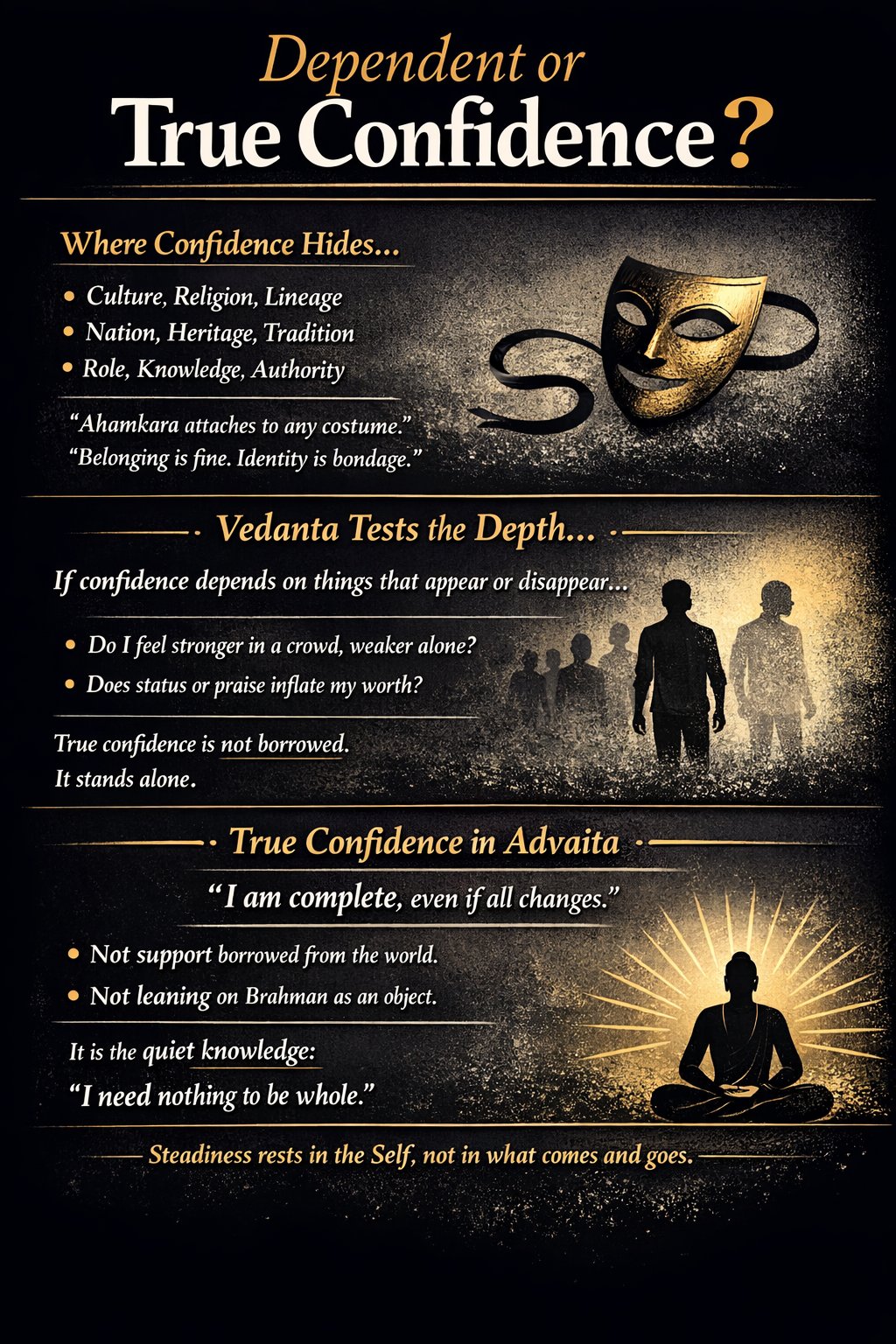
Ego Does Not Disappear – It Changes Costume
In Vedanta, ahaṁkāra is any identification of the “I” (awareness) with an upādhi, which is essentially a condition taken to be true. Most people are familiar with the ego at the personal level such as, “I am this body, this personality. I am successful. It's just not in me”.
But identification does not stop there. It easily scales up…
“I am Indian. I am Westerner.” “I belong to this culture.” “We are a superior civilization.” “I am white.” “I come from this lineage.” “Our sampradāya is the most authentic.”
The structure is identical. Only the size of the costume changes.
If one reflects honestly, it becomes clear how arbitrary this confidence is. In another life, with another body, another skin color, another birth, one might feel the same pride – just attached to a completely different culture or nation. The object changes. The identification remains.
This is why Vedanta is so uncompromising. It's ruthless. It does not negotiate with identity structures. From its standpoint, all identities – personal, cultural, national, institutional – belong to the mithyā (not-self) order.
As Swami Dayananda Saraswati (Arsha Vidya) put it with great precision…
Belonging is fine. Identity is bondage.
We cannot not belong. Even an outcast belongs to the outcast group. But the moment the “I” hardens into an identity – “I am this, therefore I am different, therefore I must defend” – bondage has quietly entered.
A simple discriminator helps here…
If it can be worn, it can be dropped. If it can be dropped, it was never you.
The Hidden Dependence Behind Confidence
Much of what we call confidence is actually dependence that has not yet been tested.
When certain objects are continuously present – money, a spouse, social connection, students, respect, status – the insecurity they prop up never gets exposed. Over time, one forgets what it felt like not to have them and mistakes the absence of threat for inner freedom.
But the real test is simple and uncomfortable…
If the object disappears and confidence disappears with it, then confidence was borrowed.
This is why Advaita is merciless…
If confidence depends on anything appearing or disappearing, it is not knowledge. It is psychological scaffolding.
The object may be gross or subtle. Early on, it may be wealth, success, or relationships. Later, it may be spiritual authority, moral superiority, or being seen as “the one who knows.” The object refines, but the leaning remains.
Why Teachers Are Especially Vulnerable
Teachers – especially spiritual teachers – are not exempt from this structure. In fact, the environment often rewards borrowed confidence.
Students reflect certainty back. Attention strengthens authority. Repetition solidifies role. Over time, confidence can quietly shift from pramāṇa (knowledge) to position (role).
Nothing dramatic needs to go wrong for this to happen. No dishonesty is required. The dependence is subtle and often invisible to the one living it.
A clean diagnostic question is this…
Does confidence rise when people gather and fall when they leave?
If yes, then something external is still being leaned upon.
This is not condemnation. It is clarity.
Then What Is True Confidence in Advaita Vedanta?
A natural question arises: If confidence cannot lean on objects, and it cannot lean on Brahman (which is formless and not an object), then what does the Vedāntin’s confidence rest upon?
The answer is precise and counterintuitive… It does not rest on anything.
True confidence is not a psychological state. It is the absence of insecurity.
And that absence comes from one thing alone: Clear, doubt-free knowledge that I am not lacking, and I am not a doer seeking completion.
This is what is meant by ātma-niṣṭhā or naiṣkarmya-siddhi. Not emotional invulnerability. Not constant composure. But the unshakable recognition…
Nothing needs to happen for me to be okay.
Here, “okay” does not mean that preferences are satisfied or life unfolds comfortably. It means that my fullness does not depend on outcomes.
Security is not placed in the changing. It is recognized as the nature of the unchanging presence because of which all change is known.
The jñānī does not lean on Brahman.
The need to lean collapses.
A Concrete Self-Inquiry (Not About Others)
This teaching is not for diagnosing other people. It is for locating your own remaining points of dependence.
Ask yourself, quietly and honestly…
If this were taken away, what exactly about me would be destroyed?
Not lifestyle. Not function. Not motivation.
Me.
If the answer still feels like “me,” dependence is active. If the answer becomes “only conditions”, then your confidence (identity) is in process of being purified.
True confidence is not loud. It does not need reinforcement. It does not rise or fall with circumstances.
It is simply this recognition, lived…
I am the constant.
The changing cannot complete me – or diminish me.
That is the difference between dependent confidence and freedom.
Putting it Into Practice
The paradox is, this article can't be put into practice, because it's the ahamkara (not-self) that's doing it. Any action reinforces ignorance, because any action is always meant to make the doer (ego) bigger and happier. But your true nature is already limitless right now.
So what what I'll do instead is get your mind to see the reality of a wise person who's figured it out. This way, your mind has a trajectory to aim for.
Unspoken perception of a jñāni…
“Nothing needs to happen for me to be okay”.
That's it.
However, above statement is only true when “okay” means my fullness / safety as Ātmā, not as in “everything is okay as long as my preferences are satisfied, I'm listened to and shown respect, people acknowledge my wisdom, etc”.
Jñani's vision can be further refined like this…
“Even if my life-situation doesn’t match my preferences, I (Ātmā – awareness) am untouched and complete.”
Above statement isn't optimism reiterated throughout the day like some affirmation that's eventually become a belief-system. A belief system can be erased or corrupted. Rather, it's an unverbalized recognition within the jñāni's buddhi.
How to “light” this confidence (the actual mechanism)
It gets lit by repeatedly seeing this logic until it becomes your default vision.
Whatever changes cannot be my source of security. (Because if it changes, it can leave, and then security would leave.)
Everything I lean on in the world is changing (role, respect, students, health, outcomes, even moods).
Therefore, security cannot be in them. Security is only in that which is present and unchanged in all states – the awareful presence.
So the confidence is… “I am the constant; the changing can’t complete me.”
Quick self-check
When you say “nothing needs to happen,” look for this tell:
If you still feel tightness / urgency / defending / proving> you’re using the sentence as a mantra.
If you feel space / non-argument / okayness even with dislike> it’s functioning as knowledge.
When you say “Nothing needs to happen for me to be okay”, what's the first situation where you notice resistance – your clients, money, health, relationships, or reputation? Be brutally honest. Just noticing is enough. You need not do anything about it.