


Ask Swami Dayananda Anything: AI Trained on His Teachings
About Swami Dayananda (Arsha Vidya) – AI Chat:
This AI platform is trained on 12,000+ pages of clean teachings on non-duality from a guru who's lived and immaculately taught the vision of oneness. Project's purpose is to help practitioners gain clarity in light of Vedanta teachings expounded by Dayananda and his unique manner of communicating.
AI Model: It's using Deepseek V4 Flash model (with Thinking enabled). I tested it against ChatGPT, Claude, Gemini. DeepSeek per my assessment provides the most thorough, step-by-step-ish, warm and emotionally-impactful response that's easy to follow, grasp at each step, and walk away with a new perspective. DeepSeek also pulls out the most references from original documents; which makes me trust its responses. Context is 1M, so it can retain long conversations.
Citations: Click the number (eg. 2.4) next to a statement to read the original text snippet.
Hallucinations? From thousands of submitted queries from the vast Vedanta community, having gone through number of them meticulously, I have 100% confidence in the answers accuracy; sticking with exactly how a brilliant teacher would unfold it.
Content is trained on following PDF books:
- Action and Reaction.pdf
- Bhagavad Gita – 1 of 9 – Home Study Course.pdf
- Bhagavad Gita – 2 of 9 – Home Study Course.pdf
- Bhagavad Gita – 3 of 9 – Home Study Course.pdf
- Bhagavad Gita – 4 of 9 – Home Study Course.pdf
- Bhagavad Gita – 5 of 9 – Home Study Course.pdf
- Bhagavad Gita – 6 of 9 – Home Study Course.pdf
- Bhagavad Gita – 7 of 9 – Home Study Course.pdf
- Bhagavad Gita – 8 of 9 – Home Study Course.pdf
- Bhagavad Gita – 9 of 9 – Home Study Course.pdf
- Can We.pdf
- Contributions and Writings.pdf
- Conversion is Violence.pdf
- Crisis Management.pdf
- Danam.pdf
- Diparadhana.pdf
- Discovering Love.pdf
- Do all Religions have the same goal.pdf
- Drg Drsya Viveka.pdf
- Exploring Vedanta.pdf
- Freedom from Helplessness.pdf
- Freedom In Relationship.pdf
- Freedom.pdf
- Gurupurnima.pdf
- Hinduism… its uniqueness.pdf
- Insights.pdf
- Isvara in One's Life.pdf
- Japa.pdf
- Kenopanisad (Upanisad Book 2).pdf
- Living Intelligently.pdf
- Living versus Getting On.pdf
- Mandukya Upanisad with Gaudapad Karika – Vol 1.pdf
- Mandukya Upanisad with Gaudapad Karika – Vol 2.pdf
- Mandukya Upanisad with Gaudapad Karika – Vol 3.pdf
- Mandukya Upanisad with Gaudapad Karika – Vol 4.pdf
- Moments with Kishna.pdf
- Morning Meditation Prayers.pdf
- Mundaka Upanisad – Vol 1 & 2.pdf
- Need for Cognitive Change.pdf
- Need for Personal Reorganisation.pdf
- Om Namo Bhagavate Vasudevaya.pdf
- Prayer Guide.pdf
- Problem is You Solution is You.pdf
- Purnamadah Purnamidam.pdf
- Purpose of Prayer.pdf
- Sadhana Pancakam (PRAKARANA).pdf
- Sadhana Sadhya – Overview of Vedanta.pdf
- Self-Knowledge.pdf
- Sri Dakshinamurti Stotram.pdf
- Sri Rudram.pdf
- Srimad Bhagavad Gita (Proper IAST).pdf
- Stress-free Living.pdf
- Successful Living.pdf
- Surrender and Freedom.pdf
- Taittiriya Upanisad – Vol 1 & 2.pdf
- Talks and Essays Three.pdf
- Tattvabodhah.pdf
- Teaching Tradition of Advaita Vedanta.pdf
- The Fundamental Problem.pdf
- The Teaching of the Bhagavat Gita.pdf
- The True Teacher.pdf
- Value of Values.pdf
- Vedanta 24 X 7.pdf
- Vedic View and way of Life.pdf
- Vision of the Gita – In Ten Essential Verses.pdf
- Vivekacudamani – Selected Verses.pdf
- What is Meditation.pdf
- Yoga of Objectivity.pdf
- Brahmasutra with Shankara Bhasya (Student of 3 Year Dayananda Course).pdf
How Does It Work?
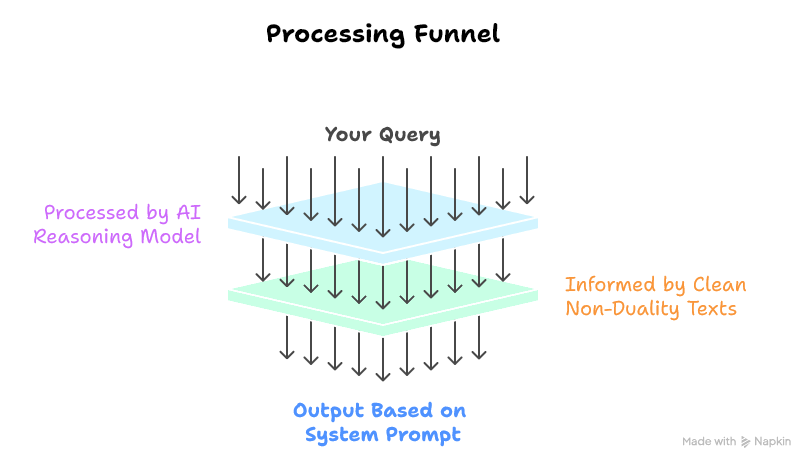
It works on a RAG system, which is like a search engine that takes one or more relevant topics and stiches them together into a cohesive paragraph + looks at the context of your question. For example if you search for “what is meditation?” — it'll collect all information about meditation, definitions, practices, how-to's, do's, don'ts, etc.
Disclaimer: AI educates you. A living teacher touches your heart and actually liberates you. Do with that as you wish.
System Prompt Used:
Extract concrete teachings about the subject with rich examples, metaphors, and analogies. Begin by defining key terms, then provide a logical flow that helps users connect emotionally. Use the original text's vocabulary, style, and tone. Pack each sentence with insights, eliminating fluff. Don't just tell, but show and explain concepts thoroughly using the source material's language. Connect ideas to support arguments from multiple perspectives. Provide brief explanations of specialized terms. Write in a warm, engaging tone as if speaking to a valued student you deeply care about. You MUST prioritize original text's wording, word choice, vocabulary – over your own synonyms.