


Summary:
Bhagavad Gita, Chapter 3, Verse 33: All beings naturally follow their prakṛti (nature), including the wise (their body-mind) who know the Self. Thus wisdom is not determined by external lifestyle or material choices but by knowledge of reality, comfort in unfamiliar situations, maintaining core values under pressure, quality decisions, mindfulness of projections, healthy self-image, recognition of Īśvara, and contributing more than taking. Each person must navigate their unique challenges orchestrated by prakṛti without comparing themselves to others. True wisdom manifests differently in different personalities and circumstances.
Bhagavad Gita, Chapter 3, Verse 34: Every sense object contains potential rāga-dveṣa (longing and aversion) which become enemies when they override svadharma (what is called for). Non-problematic likes-dislikes contribute value and follow the śreya path of necessary but often difficult action. Problematic rāga-dveṣa follows the preya path of comfortable choices, overriding duty and creating internal discomfort that requires justifying stories, leading to bitter, self-righteous personalities. The antidote involves choosing what benefits long-term welfare over personal preferences, asking whether decisions come from personal pressures or what the situation requires.
The Hierarchy of Learning:
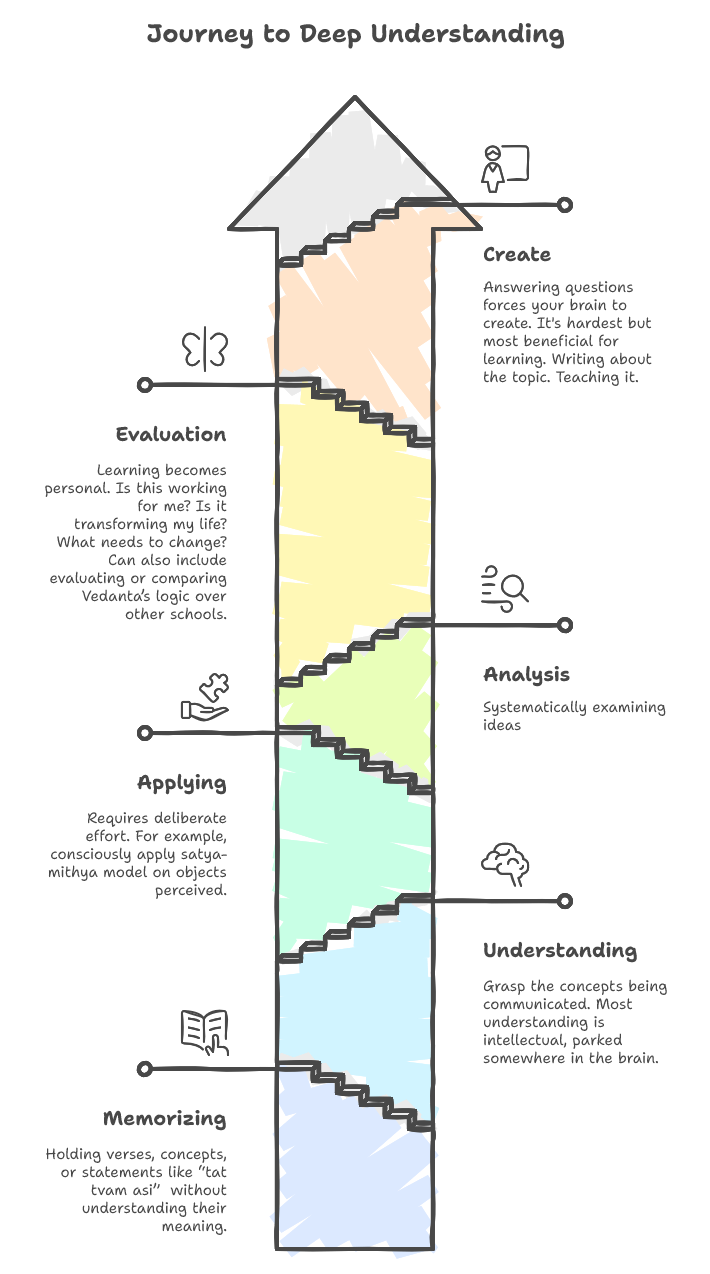
MEMORIZING
Learning exists on multiple levels, and most people remain trapped at the bottom. You begin with memorizing – simply holding verses, concepts, or statements like “tat tvam asi” without understanding their meaning. This represents empty words stored in memory, much like how ancient traditions preserved the Vedas through oral repetition.
UNDERSTANDING
The next level is understanding, where you grasp the concepts being communicated. When your teacher explains satya-mithya, how everything resolves into its final substance – you follow along and say “I understand.” Yet this understanding remains intellectual, keeping you as the safe subject analyzing objects “out there.”
APPLYING
Applying requires deliberate effort. You take your understanding of satya-mithya and consciously work with it when agitation arises or when walking and looking at objects. You analyze how your emotion depends on a person in your mind, how that person depends on having seen them in real life, how their physical form depends on atoms. This is effort – genuine work to implement what you've learned.
ANALYSIS
Analysis develops a dissecting mindset. Using anvaya (always present) – vyatireka (variable/negatable), you systematically examine what remains constant and what can be negated. Through the three states, you discover the body can be eliminated but “I” cannot. The mind can be eliminated (in sleep), but “I” cannot. This analysis reveals awareness as the one unchanging reality pervading all experiences.
Another example of Analysis is Subject-Object Distinction:
Vedanta begins with a provisional teaching that there is a subject – an observer, noticer, knower – and the known. From your standpoint, you are the subject and this face is an object. But from this other person's standpoint, they are the subject and you become the object. From any individual's perspective, all other bodies and minds are objects while they remain the subject.
This analysis reveals something profound: there can be infinite objects, but only one subject. Eight billion people can be objects to you when you are the subject. But you can also become an object to any of those eight billion, making them the subject. Through this investigation, you discover that all bodies and minds – even your thought processes – are objects, because your thoughts are objects to others, and their thoughts are objects to you.
The revelation emerges: both body and mind (emotions, thoughts, insights) are objects, and there is only that one subject. But Vedanta doesn't stop here. Even the subject you've identified – this waker subject called by your name – is also another object. Where will this waker subject be in deep sleep? It disappears. Where will this waker subject be in a dream? A different subject operates there.
The True Subject Beyond Objects
The true subject never becomes an object. It's something you cannot objectify – that in whose presence knowing (function of mind) and seeing (function of senses) takes place. This true consciousness pervades the waker subject and object in waking, the dreamer subject and dream objects, and remains present even when both subject and object resolve in deep sleep.
When your mind understands that its very substance is intelligence, this represents a unique form of knowledge. Ordinary worldly knowledge involves the mind understanding something other than itself – mind is one thing, the flying birds are something else. But when this very mind recognizes that its substance is nothing but intelligence, what the mind understands and what the mind is become identical. That's non-dual knowledge.
The understanding itself is intelligence in another form, and the very mind is also that intelligence, and the jnani's mind understands this. Whatever jnani's mind understands, is keeping with the facts – there's no split between the knower and the known. They're both just intelligence (Ishvara) reshuffling itself. This differs fundamentally from intellectual understanding where the subject remains separate from the object of knowledge.
EVALUATION
Evaluation marks where learning becomes personal. You stop comparing schools of philosophy and ask: “Is this working for me? Is it transforming my life?” You measure your progress honestly – how do you respond to the same situations now compared to months ago? You develop empathy, recognizing that everyone struggles with the same fundamental challenges, all seeking happiness according to their limited ideas.
CREATE
We're creating when answering questions. It forces the mind to take everything it knows and rearrange it into a cohesive, structured output. Creating can be in form of teaching, writing poetry, a book, or paraphrasing what's said in your own words. This is the most effective way to learn.
Learning Is Also Influenced By Your Nature
Why do some remain “lost” while others find themselves? Everyone operates according to their nature, which can be transformed through persistent effort. A sattvic mind takes simple information and applies it transformatively. A rajasic mind uses even the Upanishads for pride and identity. A tamasic mind misinterprets the finest teachings, becoming dangerous as it's convinced it's right, innocently spreading misinformation, and putting down clear sattvic thoughts.
The teaching itself matters less than the quality of mind receiving it. Give profound wisdom to a confused mind, and it becomes a source of arrogance. Give basic principles to a clear mind, and transformation follows naturally.
Your responsibility lies not in forcing understanding on others (as this is a rajasic/tamasic trait), but in knowing when you've shared your part and allowing their free will to take over.
NEXT VERSE: Reason why people are the way they are is because of their nature (which can be changed with effort & persistence)…
Bhagavad Gita, Chapter 3, Verse 33:
Everyone follows his-her nature…
सदृशम् चेष्टते स्वस्याः प्रकृतेः ज्ञानवान् अपि ।
प्रकृतिम् यान्ति भूतानि निग्रहः किम् करिष्यति ॥ ३-३३॥
sadṛśam ceṣṭate svasyāḥ prakṛteḥ jñānavān api ।
prakṛtim yānti bhūtāni nigrahaḥ kim kariṣyati ॥ 3-33॥
Even a wise person acts in keeping with his or her own nature. Because all beings follow their own nature, of what use is control?
“All beings follow their own nature”:
Each person has to go through their unique set of challenges in one's own way – orchestrated and governed by prakriti (impersonal laws/orders that govern objects/behaviours). There’s no competition to the finish line.
“Even wise person’s body is governed by prakrti”
Remember, Krishna’s definition of a “wise person”, is one who knows nature of Self.
In Mahabharata – Krishna, Vidur, Vyasa are wise people, and in Ramayana – Rama, Janaka, Vashistha. All had different lifestyle, different likes/dislikes.
Statement shows that what makes wise person is not about exterior, such as how materially rich or simple they are, whether one teaches or not, whether one is verbal or quiet.
For instance, giving up everything may appear wise to many, but act may be coming from escaping life, proving to oneself they don’t need things, because that’s what a spiritual person is. Or one might be coming from unfounded beliefs or fear of God punishing for having material possessions.
Indicator of wisdom isn’t necessarily about what you give up or don’t.
Some indicators of wisdom (from B.G) are:
-
- What you know about reality is keeping with reality (vastu-tantra).
- How comfortable you are in unfamiliar situations.
- Whether you compromise your core values when tempted.
- Quality of your decisions.
- Whether you’re mindful if projecting onto self/others, and ability to stop.
- Having a healthy self-image. Maning able to see your own superiority/inferiority complexes, and still respond thoughtfully.
- Whether you recognize presence of Ishvara.
- Ratio of contributing vs. taking.
Conclusion: So Krishna encourages us to live our own unique life according to our nature, and stop comparing ourselves to others.
NEXT VERSE: What derails you from living out your nature is [binding] likes-dislikes…
Bhagavad Gita, Chapter 3, Verse 34:
Enemy taking you away from your nature…
इन्द्रियस्य इन्द्रियस्य-अर्थे राग-द्वेषौ व्यवस्थितौ ।
तयोः न वशम् आगच्छेत् तौ हि अस्य परिपन्थिनौ ॥ ३-३४॥
indriyasya indriyasya-arthe rāga-dveṣau vyavasthitau ।
tayoḥ na vaśam āgacchet tau hi asya paripanthinau ॥ 3-34॥
There are longing and aversion (potential) in every sense object. May one not come under the spell of these two because they are one’s enemies.
In each situation, we make a decision in two ways:
1. WHAT IS CALLED FOR (SVADHARMA):
What is required in each situation and do what is called for. Mindful about the long term impact on self and others.
2. RAGA-DVESHA:
-
- Based on likes/dislikes, which everyone has. They make each person unique in talent, skill and personality. For instance, you may like Chinese, I like Indian food. Likes/dislikes facilitate conversations. Thus we can’t entirely give up likes-dislikes; else that’s a robot.
- Likes-Dislikes are Non-Problematic When:
- Their acts contribute and add value to people’s lives. Example: Someone likes to ask questions, paint, look into details, manage people. These create no conflict. This is taking the path of shreya – path of hard, but neccessary.
- Likes-Dislikes are Problematic When:
- Your acts override what is to be done. Meaning harmony is disrupted and your mind loses perspective. They make you get (yoga) and retain (kṣema) at any cost.
- Yielding this path (called preya – path of comfortable, easy and pleasant), creates undercurrent of discomfort in you and the situation. As discomfort grows, one needs to create a story to justify things are fine, each time distancing you further from what you are supposed to do. Eventually, this creates a bitter, self-righteous personality which easily gets offended when challenged, thus resorts to victim mode how others are at fault. EG: Suppose wife is supposed to apologize for criticizing her husband publicly. Meanwhile, she tells herself a story what she did was justified, to cover the dharmic whisper of “what I did was unfair”. Husband confronts her about it. She snaps, “You’re overacting. Man up!”, gaslighting, etc.
- More Examples:
- Your inner conscience produces a desire to reach out and help. But your comfort zone overrides it. Few moments later, you feel unwell for not having acted.
- You’re perturbed by his/her impatience, thus your words come out in condescending tone. When he calls you on it, you play the victim.
- Antidote to being ruled by likes-dislikes: Choose what is called for, over your raga-dvesha. Is what you’re about to do beneficial long term? If he or she sees you on a public train or bus, will the last conversation you've had lead to a pleasant exchange, or hiding from him/her?
Mahabharata shows several examples where decisions were based on raga-dvesha:
- Arjuna’s fighting and non-fighting was based on raga-dvesha.
- Longing to avenge Kauravas.
- Wanting to leave to Rishikesh. It wasn’t based on what was required, which was that Arjuna was a fit warrior, and had a responsibility towards the welfare of Hastinapura.
- Arjuna goes to Indra for weapons.
- Pandavas letting go Kauravas mistreatments was based on raga-dvesha (unwilling to rock the boat).
- Arjuna collapsed and said, “I can’t fight as my loved one’s are on other side”. If Arjuna ran away, he would’ve thought it was due to his pull for moksha, but it’s driven by raga-dvesha.
Pandavas can be seen as archetypes of raga-dvesha expressions:
Bhima: Let’s fight (active anger). Yudhisthir: Letting go (passive anger).
Real life story illustrating when person did not succumb to their likes-dislikes (let go) when confronted with conflict:
Situation: A brother persuaded their mother to rewrite her will, falsely claiming their sister (who was away) agreed; after the mother’s death the sister discovered the brother was named sole heir.
Response: Rather than react with blind anger or passive resignation, the sister called her brother and said calmly, “How would you feel if I had manipulated mother to leave everything to me? Think about it.” She then hung up to give him space.
Outcome and motive: The brother later phoned to apologize. The sister’s action was neither passive nor aggressive – she acted from duty and principle, doing what needed to be done without seeking revenge. Even if the brother had done nothing, she could still feel satisfied that she had taken the right, factual step.
True test of spirituality: Biggest challenge is rising above your raga-dvesha, going against your personal fancies, evaluating the situation, and responding appropriately.
Practical: In every situation, ask yourself, “Where are my decisions coming from, my own pressures, or what is called for?”
NEXT VERSE: What is means to follow your nature…
—
Course was based on Swami Dayananda (Arsha Vidya) home study course.
Recorded 7 Sept, 2025